


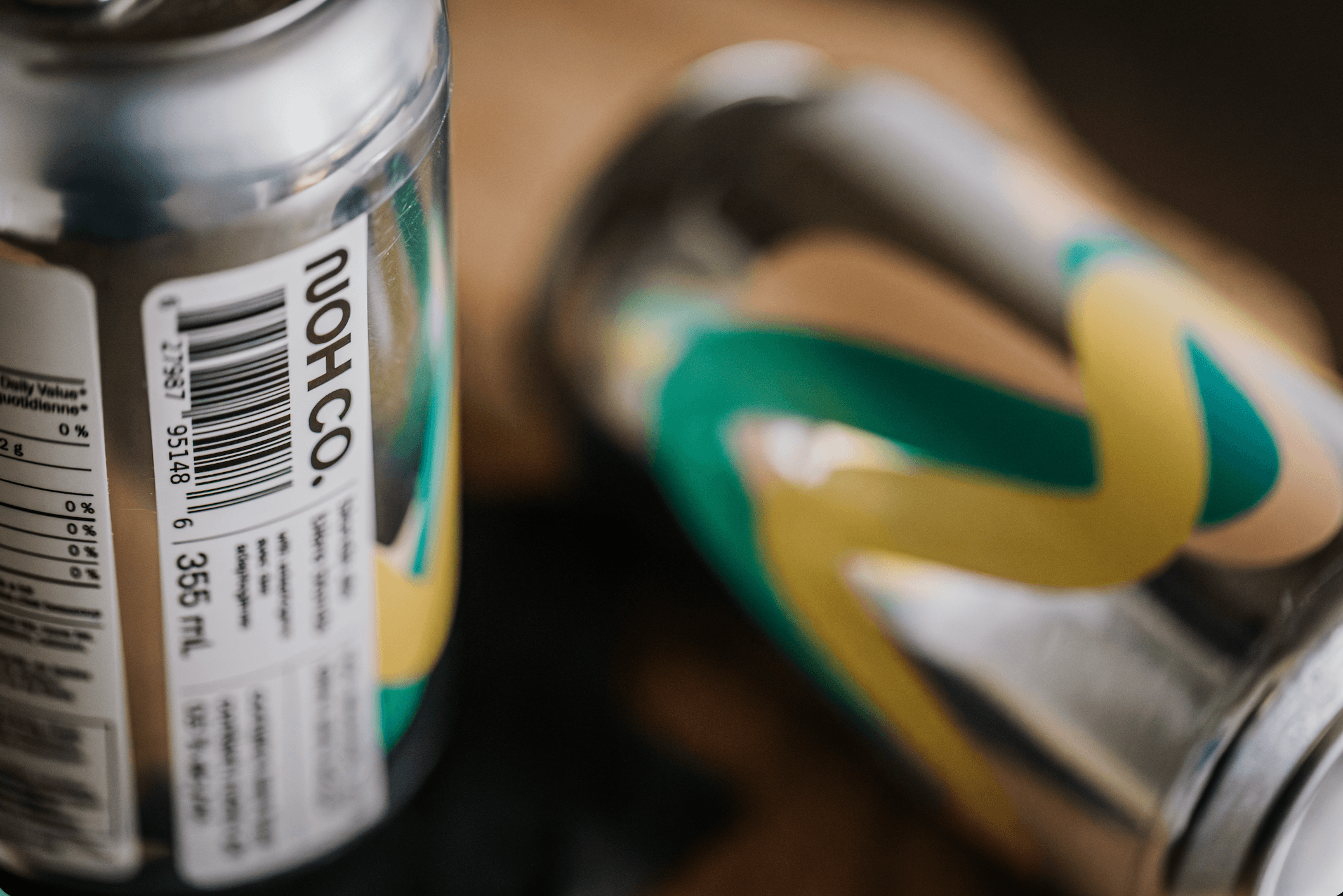
A plain-English guide to Sunrise 2027 and why your next label order is the right time to get ahead of it.
If you’ve been hearing the phrase “Sunrise 2027” lately and weren’t entirely sure what it meant, you’re not alone. It sounds like a policy document, and honestly, a lot of the coverage reads like one too.
So let’s fix that. Here’s what Sunrise 2027 actually is, what it means for your products, and what you actually need to do about it.
First: What Is Sunrise 2027?
Sunrise 2027 is a global industry initiative led by GS1 (the international organization that manages barcode standards) to transition retail from traditional 1D barcodes (like the UPC you’ve seen on every product since the 1970s) to more advanced 2D barcodes like QR codes and DataMatrix codes.
The goal: by the end of 2027, point-of-sale systems at retailers around the world will be able to scan and process these newer 2D codes, just as easily as they scan a UPC today.
Why Does This Matter for Your Brand?
Because your label is ground zero for this change.
Everything about Sunrise 2027 (whether you’re a brand owner, a food manufacturer, a retailer, or a small business that sells products on shelves) eventually comes down to what’s printed on your label. And the window to get it right is narrowing faster than most people realize.
Here’s the data that tells you why this matters beyond compliance:
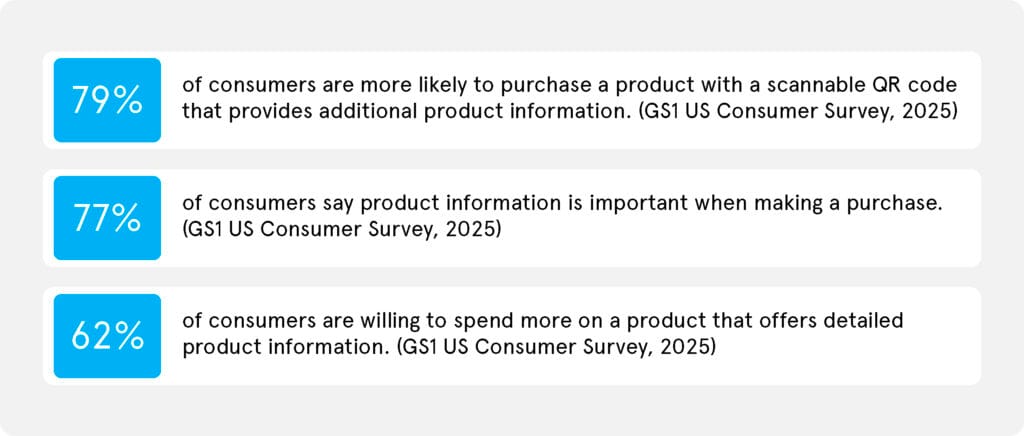
This isn’t just a technical upgrade, it’s a consumer expectation that’s already here. Sunrise 2027 gives brands a standardized way to meet it.
Let’s Clear Up the Biggest Misconception
Many people hear “2027” and think: “I have time. I’ll deal with it later.”
Here’s the reality: 2027 is not a hard cutoff where everything switches off. It’s the year the industry expects to reach a critical mass of retailers able to scan 2D barcodes at checkout. Traditional 1D UPC barcodes are not being banned. During the transition, most products will carry both a 1D and a 2D barcode side by side.
But here’s where urgency is very real: labels printed today may still be on retail shelves in late 2027. If you’re planning a packaging refresh, updating your artwork, or ordering labels in mid-to-late 2026, that is exactly the right moment to build 2D compliance in. Doing it twice costs time, money, and label waste you don’t need.
What’s Actually Different About a 2D Barcode?
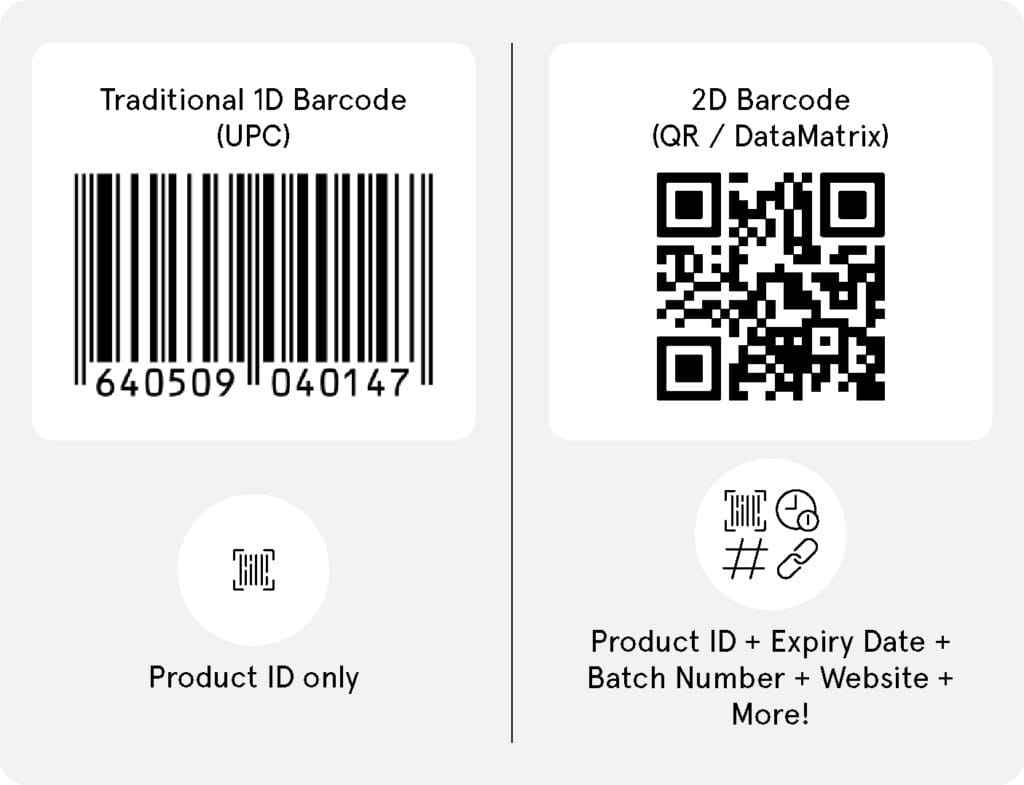
Traditional UPC barcodes (the striped 1D kind) can only store one thing: your product’s Global Trade Item Number, or GTIN. That’s it. A single identifier that tells the scanner “this is the product.”
A 2D barcode (whether it’s a QR code or a GS1 DataMatrix) can hold all of that plus:
- Batch and lot numbers
- Expiry or best-before dates
- Serial numbers for individual item tracking
- A web link (via GS1 Digital Link) that connects the physical product to a live, updateable online experience
- Sustainability and sourcing information
- Allergen and ingredient details
- Recall and traceability data
And unlike a UPC, a 2D barcode can be scanned by a regular smartphone camera, meaning your customers can access all of that information from the shelf, without any special equipment.
The Three Types of 2D Barcodes Approved for Retail
GS1 has approved three 2D barcode formats for use at retail point-of-sale:
- QR Code with GS1 Digital Link URI: The most consumer-familiar format. Scannable by smartphones. Can link to a live web page with real-time product data.
- GS1 DataMatrix: A compact square code well-suited to small labels, fast production lines, and regulated industries like pharma and food.
- Data Matrix with GS1 Digital Link URI: Combines the compact size of DataMatrix with web-link capability.
Not sure which format is right for your product? That’s exactly the conversation to have with your label specialist.

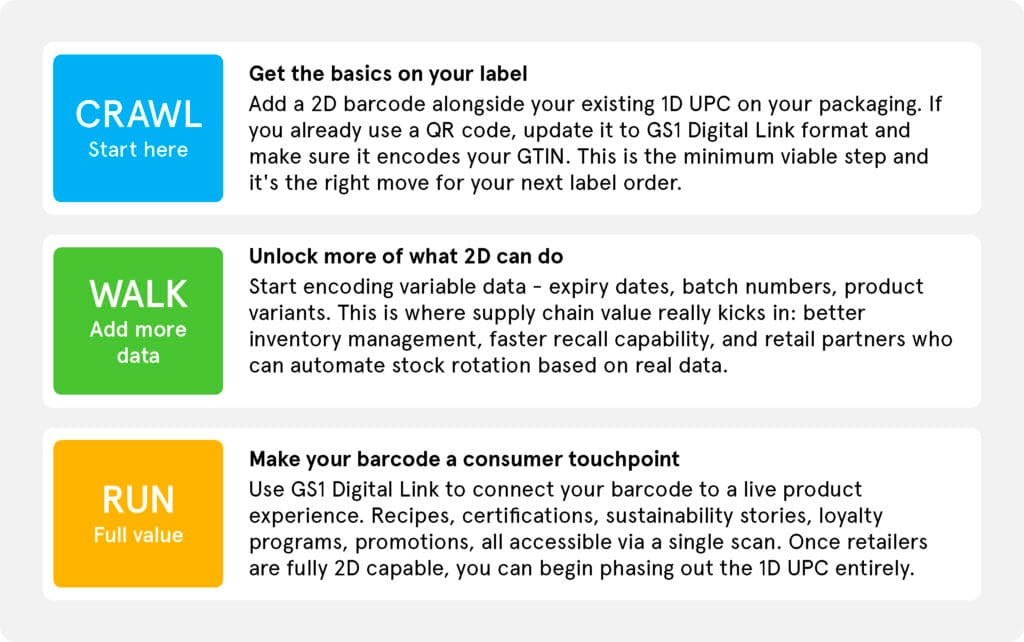
The Crawl-Walk-Run Roadmap: What to Do and When
GS1 recommends a phased approach to adoption, and it’s genuinely sensible advice. You don’t have to do everything at once. Here’s how to think about it:
What Does This Mean for Your Labels Specifically?
This is where it gets practical and where having the right label partner matters.
A few things to know before your next label run:
- Placement matters.
GS1 recommends placing your 2D barcode within 50mm of your existing UPC to avoid scanning errors in retail environments. This affects your label artwork layout, so it’s worth planning ahead rather than retrofitting.
- Print quality is everything.
2D barcodes are made up of dense arrays of tiny modules. If the print quality isn’t right (the contrast isn’t sharp, the modules aren’t clean) the code won’t scan reliably. This is not a place to cut corners, and it’s why your printer’s capabilities matter as much as your design.
- Static vs. dynamic printing.
A static 2D code contains fixed information, like a standard QR code printed on a pre-press label roll. A dynamic code includes variable data (like expiry dates or batch numbers) printed inline during production. If you need dynamic codes, your label solution needs to support variable data printing. This is something to discuss with your label supplier before you finalize your artwork.
- You don’t need a new GTIN.
Good news: the same GTIN already in your UPC gets encoded in your 2D barcode. No new product number needed. You just need to format it as a 14-digit number (add two leading zeros to a standard 12-digit UPC).
A Quick Checklist: Where to Start
If you’re unsure where you currently stand, here’s a simple starting point:
- Do your current labels have a 1D UPC? (Yes – then you already have your GTIN, which is the foundation.)
- Do you already use a QR code on packaging? (If yes, is it encoded with GS1 Digital Link standards? If not, now is the time to update it.)
- Do your products have expiry dates or batch numbers? (If yes, dynamic 2D printing will eventually be important for you.)
- Are you planning any packaging updates or artwork revisions in the next 12 months? (If yes, build 2D compliance into that update now, don’t do it twice.)
- Have you talked to your label supplier about Sunrise 2027 readiness? (If not, that conversation should happen before your next order.)
Your Labels. Your Deadline. Let’s Get It Right.
At Multi-Action, we produce labels across a wide range of formats, materials, and printing processes, including the variable data printing capabilities that Sunrise 2027 will increasingly require. We work with brands at every stage of this transition, from adding a first 2D code to a label all the way through to fully serialized, dynamic barcode production.
If you’re unsure whether your current label setup is Sunrise 2027 ready (or if you’re planning a label refresh and want to build compliance in from the start) we’re happy to walk you through it.
➡ Talk to our team about your next label order. We’ll make sure it’s ready for what’s coming.
Frequently Asked Questions
Is Sunrise 2027 mandatory for brands?
The Sunrise 2027 initiative is primarily a readiness target for retailers, ensuring their POS systems can scan 2D barcodes. For brand owners, the transition to 2D is currently voluntary. However, as more retailers become 2D capable and begin expecting it, brands that have already made the transition will be better positioned. Starting now is a strategic advantage, not just a compliance exercise.
Will 1D UPC barcodes disappear after 2027?
No. Linear UPC barcodes will not be banned or made invalid. During the transition period, products are expected to carry both a 1D and a 2D barcode. Eventually, once 2D scanning is universal, brands will have the option to phase out the UPC – but that’s a gradual, voluntary process.
Do I need new packaging to add a 2D barcode?
Not necessarily. Many brands start by adding a 2D barcode alongside their existing UPC during their next scheduled label or packaging update. The key is planning the placement and print quality correctly from the start, ideally with your label supplier involved early.
What’s the difference between a regular QR code and a GS1-powered one?
A regular QR code just links to a URL. A QR code with GS1 Digital Link encodes your product’s GTIN as part of that URL, in a standardized way that retail POS systems can read and process. It can also carry additional product data within the code itself. This standardization is what makes it scannable at checkout, not just by smartphones.
How do I know if my label printer can handle 2D barcodes?
Most modern label printing systems can produce 2D barcodes. The more important question is whether your setup supports variable data printing, which is needed if you want to encode batch numbers or expiry dates dynamically. That’s the conversation to have with your label supplier before your next order.